
Voice AI agent case study: the phone rings, the agent answers.
The voice agent is the AI phone support agent Paul Rahme built for a US marina-software company and its marina-management product: a voice AI agent that answers every support call, verifies the caller, answers from the product's documentation, and creates a Zendesk ticket for every verified call. It is on production calls at the client today; before go-live the full call flow was validated in live testing. Built at the marina-software client as their AI automation engineer; Aldenebai builds the same systems for other companies.
The phone line before the voice agent
A support phone line is the ticket queue with the wait made audible. Someone picks up, asks who is calling, finds the account, works out whether it is a how-to question or a bug, looks the answer up, explains it, then writes the ticket afterwards so the call exists on record. Most of what is said on those calls is already in the documentation; the person on the phone is reading it aloud.
The system: an AI phone agent that creates Zendesk tickets
The voice agent picks up, greets the caller, and confirms what they need. Then it verifies them: phone number first, then an email address or the company or marina name. Once verified, the request is sorted into one of four types (how-to question, known issue, missing documentation, feature request), looked up in the product's documentation, and explained in plain language. Docs only; if the documentation does not cover it, the voice agent does not improvise.
Every verified call becomes a Zendesk ticket. Bugs, feature requests, and documentation gaps are filed automatically as GitHub issues. When a call needs a person, the voice agent transfers to a live agent and leaves a note. It handles interruptions and closes politely. Under the hood it shares its shape with the text support agent built for the same company: real-time understanding, intent handling, LLM responses inside guardrails.
What the humans keep
Account changes, billing, and refunds: the voice agent transfers those. Anything the documentation does not answer goes to a person too. What arrives is already a ticket, and the bug or gap it surfaced is already an issue. The agent takes the repetition; the humans take the exceptions.
Where it still stumbles
Two known limitations, both still monitored in production. An email address spelled out aloud is sometimes mis-heard. Very rarely, a transfer drops during hand-off. Both are on the record.
Status
Call volume is a rounded monthly average from production, around 100 calls a month; resolution and transfer figures are not yet published. The 8/10 is the pre-launch readiness score; the two known limitations, listed under "Where it still stumbles" above, were found in live testing and are still monitored.
What a voice-agent call leaves behind
Illustration of the system's output, not a production screen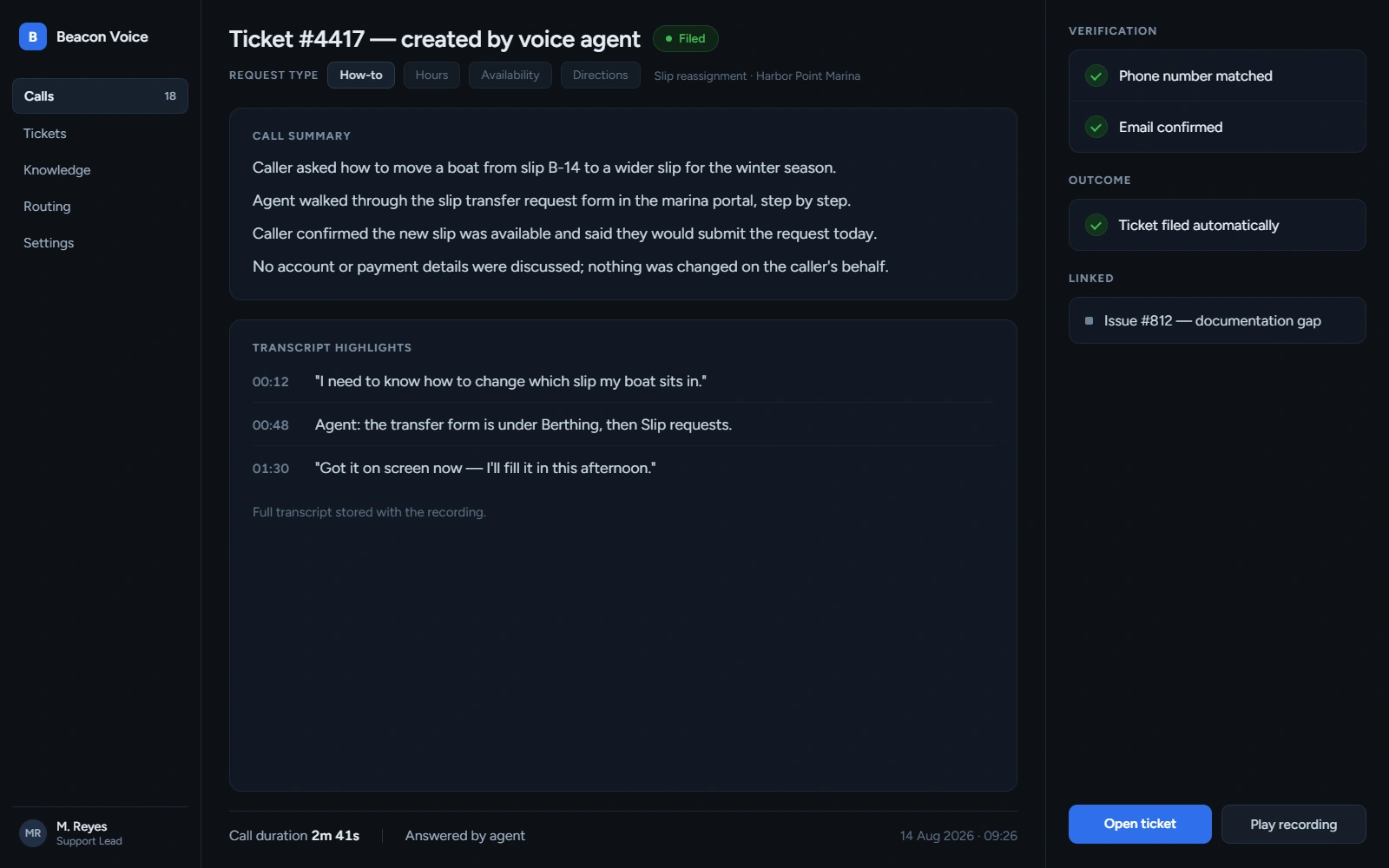
What people ask about putting a voice agent on the phones
Is the voice agent live in production today?
Yes. The voice agent answers production calls on the client's support line. Before go-live the full support-call flow was validated in live testing and rated 8/10 on readiness; it now answers around 100 calls a month, a rounded monthly average; resolution and transfer figures from production are not yet published, so this page shows the readiness score alongside the volume.
How does an AI phone agent that creates Zendesk tickets know who is calling?
It verifies before it logs. The voice agent asks for the phone number first, then an email address or the company or marina name. Only a verified caller gets a Zendesk ticket; for an unverified caller the voice agent creates nothing and promises nothing.
What did the 8/10 readiness score measure?
That the whole call, greeting to verification to answer to ticket to close, had run end to end in live testing rather than a scripted lab. It is the score from the last review before the voice agent took the line. The two known limitations at that point, a mis-heard spelled-out email and a rare dropped transfer, are documented and still monitored in production.
What will the voice agent refuse to do on a call?
Make up an answer: if the documentation does not cover the question, it routes the call rather than guessing. Create a ticket, or promise one, for a caller it could not verify. Handle account changes, billing, or refunds: those are transferred to a live agent with a note.
Related pages
The next case is your phone line.
The free Automation Audit maps what your callers ask, what the docs already answer, and what a voice agent could take. 30 minutes, remote, written Automation Map within 48 hours.