
AI support agent case study: six in ten tickets closed with no human.
The marina-software client makes marina-management software with a support queue that was absorbing engineering time. Paul Rahme designed and shipped an autonomous, guardrailed AI support agent that triages, answers, and closes tickets end to end. About six in ten incoming requests are now resolved with no human intervention, and first response dropped from hours to seconds. Built at the marina-software client as their AI automation engineer; Aldenebai builds the same systems for other companies.
The marina-software support queue before the agent
Support requests arrived around the clock and waited for a person. The same how-to questions and known issues came back week after week, each one answered by hand from documentation that already existed. Anything technical pulled an engineer off product work. First response was measured in hours, and a backlog had built up that nobody had time to clear.
How the AI support agent resolves about 60% of the client's tickets without a person
An autonomous agent that works inside the existing support workflow. It triages each incoming request by intent and urgency, retrieves the answer from the product's documentation and the systems it is allowed to read, drafts a plain-language reply, and scores its own confidence. Above the threshold, it replies and closes the ticket. Below it, the ticket lands with a person, with the agent's notes attached: the intent it assigned, the sources it found, its draft, and why it stopped. The agent also worked through the historical backlog. Every read, decision, and reply is logged, and quality is monitored continuously so drift is caught rather than discovered.
What the support team does now
Engineers see the tickets that need judgment: ambiguous requests, account and billing matters, anything the agent was not confident about. The repeat questions, the overnight tickets, and the backlog are handled by the machine. The corrections humans make feed back into the thresholds and the knowledge the agent answers from.
Results: ~60% auto-resolved, first response in seconds, 24/7
Rounded from production data at the marina-software client. Definitions: a ticket counts as resolved with no human touch when the agent answers and closes it without a person editing or intervening; tickets routed to a person at triage count as escalations, not resolutions. Reopen rate: about one in ten auto-resolved tickets is reopened by the customer or the team, rounded from production data. Net of those reopens, a little over half of incoming requests stay closed with no person involved. Escalation rate and monthly volume are not published on this page.
Book the Automation Audit
The receipt
Illustration of the system's output, not a production screen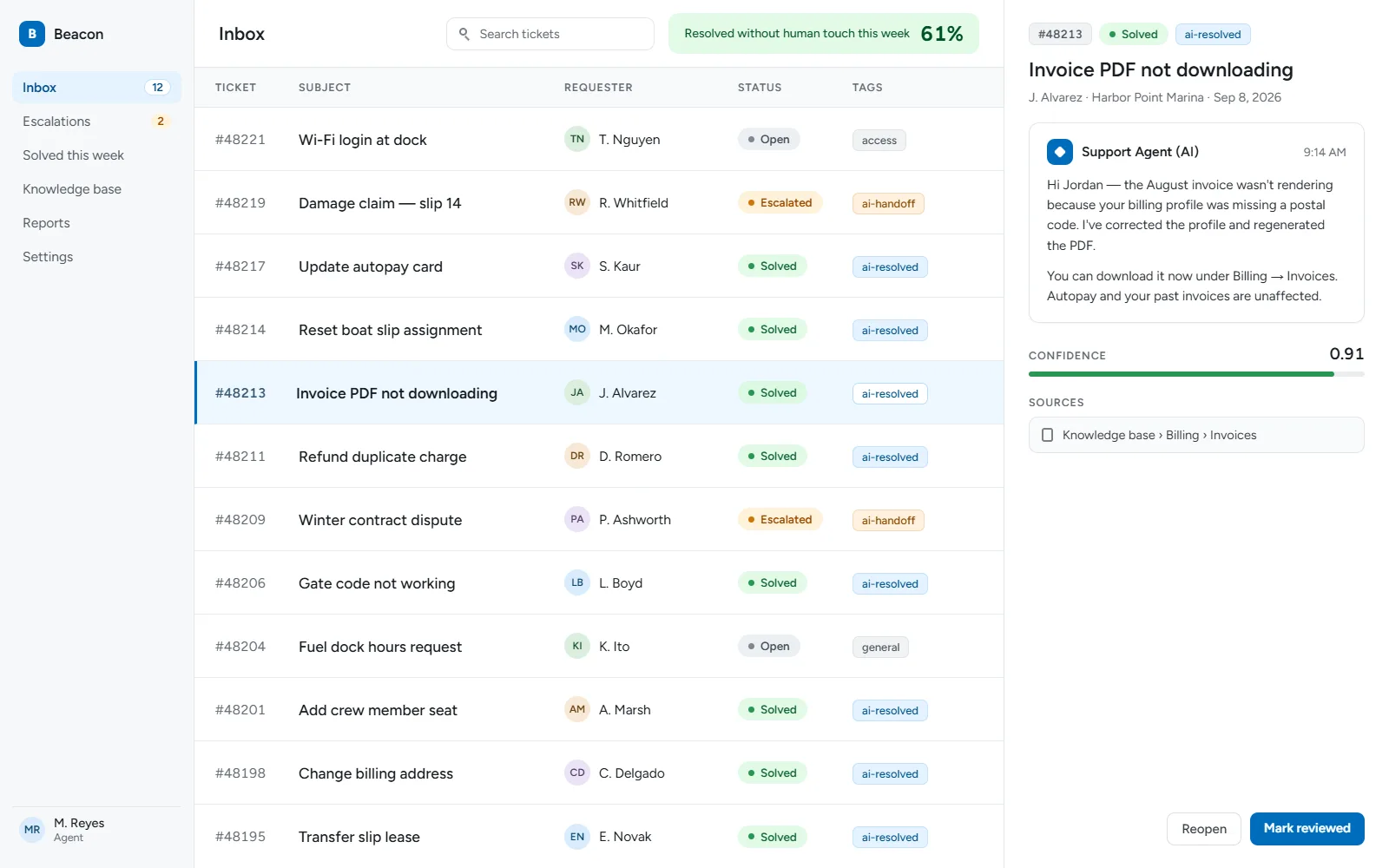
Questions about the client's support agent
How does the agent avoid making things up?
It answers only from approved sources: the product's documentation and the systems it is allowed to read. If the answer is not written down somewhere, it does not invent one. Below the confidence threshold, nothing is sent and the ticket goes to a person.
What happens to the other 40%?
They reach a human faster and better prepared than before. The escalated ticket arrives with the agent's triage, the sources it pulled, its draft, and the reason it stopped, so the person starts from a summary instead of from scratch.
Which models does it run on?
Claude on AWS Bedrock, with Gemini where it fits the task, orchestrated by a Python service that owns the pipeline and every decision in it. The models can be swapped without rebuilding the system.
Which helpdesk does it run in?
Zendesk. The agent works the tickets in the client's existing Zendesk instance through the API and sets a tag for every outcome, so the resolution and reopen figures above are ordinary Zendesk reports, auditable ticket by ticket. The helpdesk adapter is the only part that changes for another tool.
How long did it take to go live?
About a month from kickoff to the first ticket handled in production, on the existing Zendesk instance and documentation. Your own timeline depends on both, and the Automation Audit gives you a written estimate for it.
Could this run on our support queue?
Yes, if you have a ticketing tool and documentation that is at least partly written down, very likely. The Automation Audit maps your ticket volume, tools, and escalation rules and estimates your resolution rate before you spend anything. The method is written out in how to automate customer support with AI.
Related pages
Your queue is the next number on this page.
The free Automation Audit writes its first page: 30 minutes, written Automation Map included.