
Shasha Media test automation case study: web, TV, and mobile in one suite.
Eurisko delivers software for Shasha Media, a media streaming service in Kuwait with apps on web, TV, and mobile. As Senior QA Automation Engineer and Senior Developer, Paul Rahme designed and built the end-to-end automation frameworks that replaced repetitive manual QA across all three platforms, cutting manual regression testing by about 70% and shortening release cycles.
QA at Shasha Media before the frameworks
A streaming platform breaks in ways a website does not. Video playback, recommendations, and user management have to work on a browser, on a television, and on a phone, and every release meant checking all three by hand. The same flows were retested on every platform, every cycle, by people who could have been finding the bugs a checklist never catches.
The test frameworks Paul Rahme built across web, TV, and mobile
End-to-end frameworks built for reliability first: Cypress and WebdriverIO in TypeScript, with Cucumber so the scenarios read as plain language the product team could follow. Coverage spanned playback, recommendations, and user management on the web, then extended to TV and mobile apps with Appium so one suite exercised the whole platform. API testing ran alongside the UI suite for content retrieval, authentication, and security, catching backend regressions before they surfaced on a screen. The frameworks were increasingly AI-assisted as they grew, the step that later became a fully self-generating pipeline.
What the QA team did once the suites ran
Regression is a run, not a week. Testers spend their time on exploratory work and on the judgment calls about what quality means for a streaming product. The frameworks also became the foundation for the AI test-generation pipeline now running at the marina-software client: the discipline of reliable end-to-end coverage, with the human effort of writing and maintaining it removed.
Results: about 70% less manual regression
Rounded from project data at Eurisko; how the figure is counted is noted on this page.
Book the Automation Audit
The receipt
Illustration of the system's output, not a production screen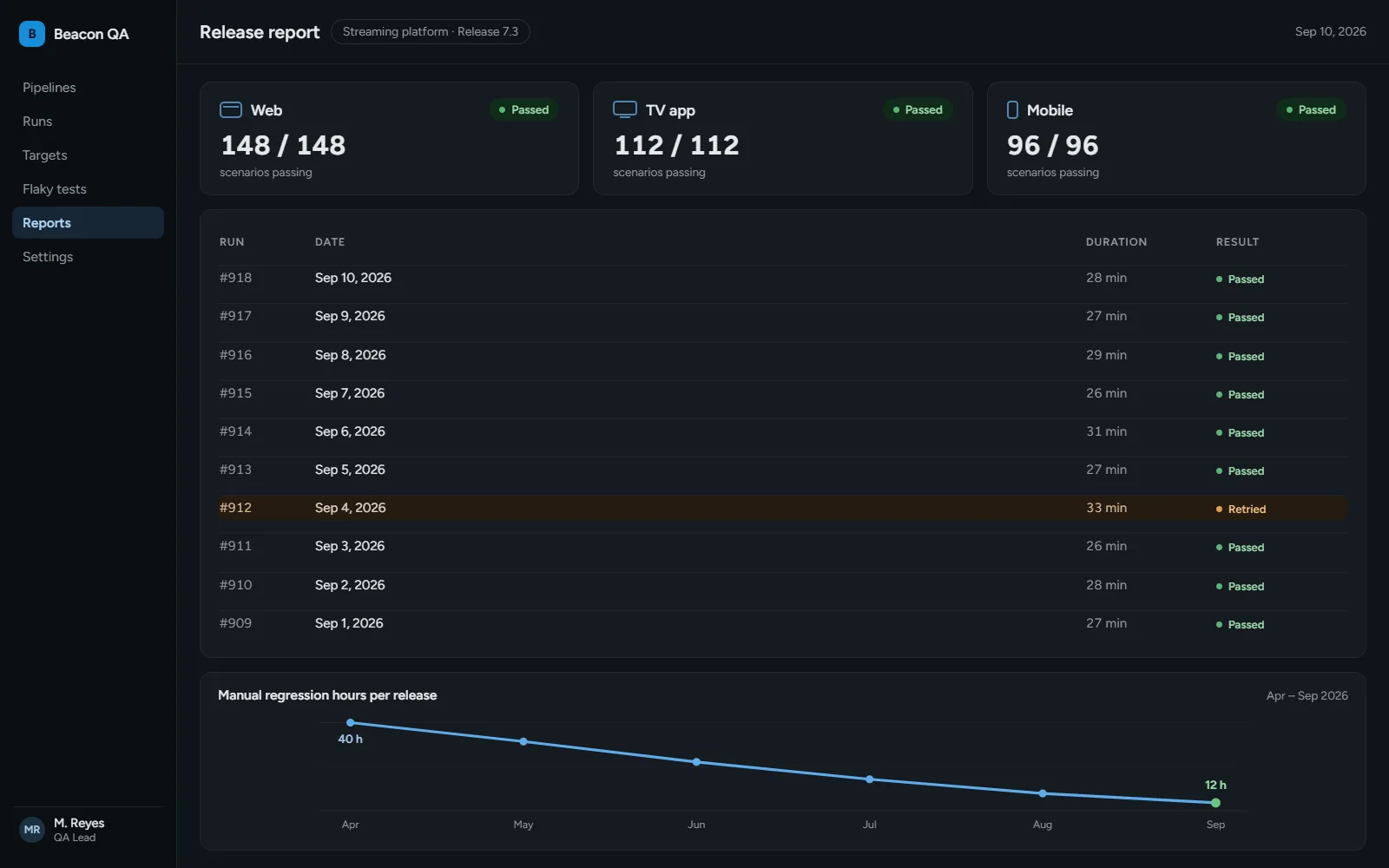
Questions about the Shasha Media frameworks
How do you automate testing on a TV app?
With Appium driving the TV and mobile builds the same way WebdriverIO drives the browser, so the same scenarios run on all three. The hard part is stability: video playback and remote-control navigation need patient, signal-based waits rather than fixed timeouts.
Why Cucumber?
So the scenarios read as plain language. Product and QA could agree on what a feature should do in words, and the same words ran as tests. Tags then drove which scenarios ran on which platform and in which pipeline.
What did the API testing add?
Backend regressions caught before they reached a screen: content retrieval, authentication, and security checks run on every build, faster and more precisely than any UI test could.
How does this connect to Aldenebai's AI systems?
Directly. This is the discipline the AI test automation pipeline is built on: reliable end-to-end coverage, run in CI, gating releases. The AI layer removed the human effort of writing and maintaining it.
Related pages
Bring the release that takes a week to test.
The free Automation Audit writes its first page: 30 minutes, written Automation Map included.