
Invest Kenya case study: a national investment platform, built and verified.
Invest Kenya is a national investment-promotion web platform, delivered under a McKinsey & Company engagement from Dubai, and Aldenebai's founder built its front end and tested it. Investment promotion platform development means a content-heavy site that must convince a foreign investor on any device, in any browser, by a public launch date. One engineer carried both front-end development and QA for the McKinsey project: a responsive UI, then functional, cross-browser, and integration testing on every change, so the platform launched verified.
Invest Kenya before the platform
A national investment-promotion platform has one job: convince an investor who has never heard of you, on whatever device they hold, that the country is worth their money and the process is clear. That means pages of content, forms, and data that must render the same on a phone in Nairobi as on a desktop in London, on a launch date the public already knows. Every UI change risks breaking a page in a browser nobody on the team uses. Checking all of it by hand, after every change, is the grind. It is also the first thing skipped when the timeline is tight.
The system Paul Rahme built
Aldenebai's founder, Paul Rahme, held two roles on the McKinsey project at once: front-end developer and QA. The front-end work was a responsive UI: layouts and components that hold on desktop, tablet, and mobile. QA ran alongside the build, not after it: functional testing of every page and flow, cross-browser testing in the browsers investors use, and integration testing where the front end met the services behind it. One person building and testing is the point: the developer knows where the fragile parts are, and the tester needs no hand-off to find them.
What shipped
A national platform that launched verified. Pages that rendered the same across browsers. Flows exercised end to end before an investor saw them. It is how Aldenebai builds today: the person who writes the front end proves it works, and the release goes out with a test log rather than a crossed finger.
What the engagement delivered
No public figures exist for this engagement; results are described qualitatively.
Book the Automation Audit
The receipt
Illustration of the system's output, not a production screen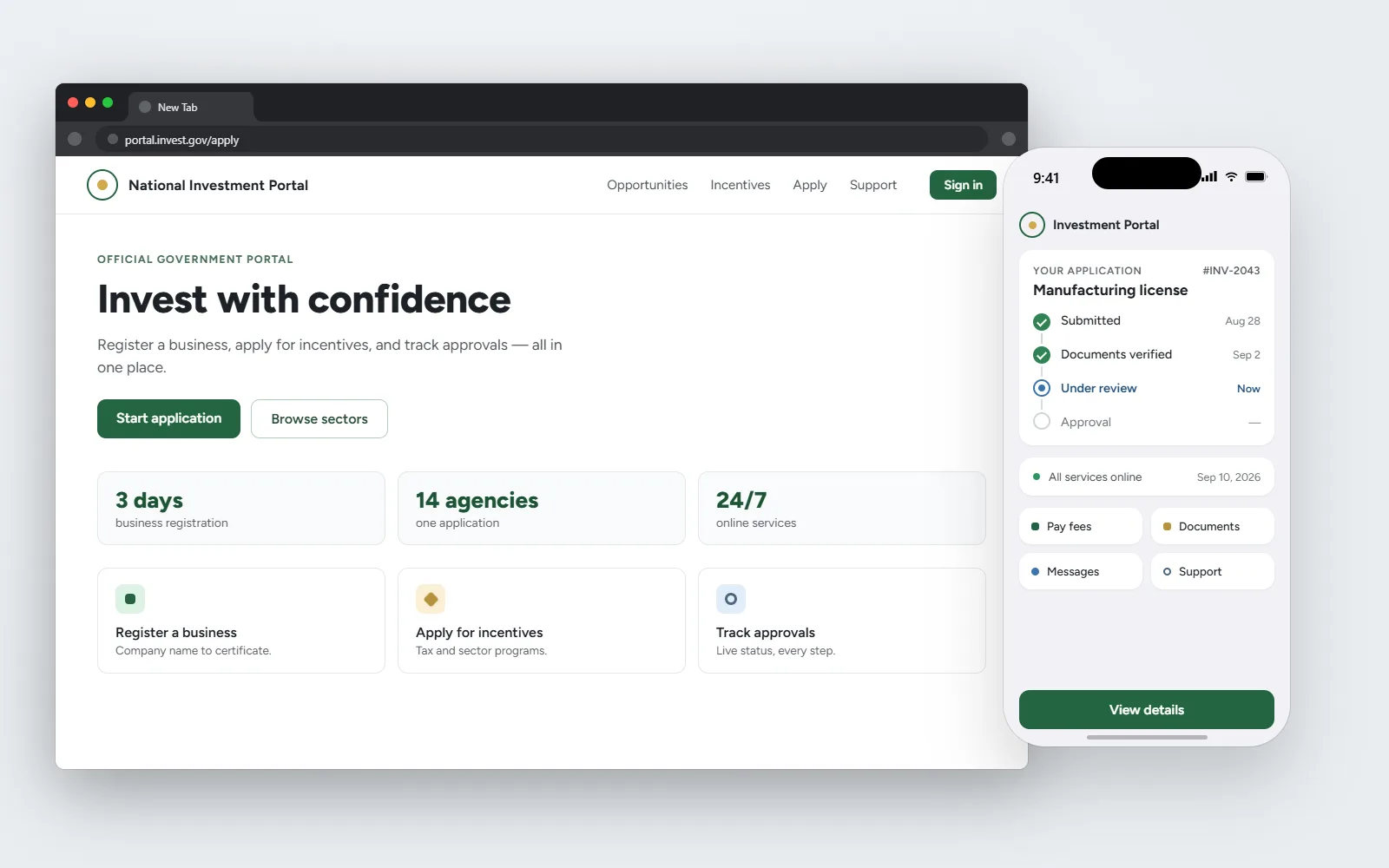
What people ask about building and testing a national platform
What does investment promotion platform development involve?
An investment-promotion platform is a national or regional website that presents a country's sectors, incentives, and procedures to foreign investors and leads them to a first contact. Development means a content-heavy front end that must work on any device and browser, plus the integrations that pull in data and route enquiries. Because the audience is global and the launch is public, quality assurance is part of the build, not a phase at the end.
What did front-end development and QA for the McKinsey project actually cover?
Two roles, one engineer. On the front end: the responsive UI for the Invest Kenya platform across desktop, tablet, and mobile. On QA: functional testing of pages and flows, cross-browser testing, and integration testing where the front end met the services behind it.
Why does quality assurance for a national web platform launch need to run alongside development?
Because a national launch has a public date and no quiet period. On a tight timeline, QA that waits for a feature freeze never gets its full run; the last changes ship untested. Testing as the UI changed meant each change was checked in the browsers it would be seen in, and the launch build had already been exercised. It is why Aldenebai's AI test automation runs regression on every change rather than once before release.
Is this the kind of build Aldenebai takes on today?
Yes. Web platforms are one of Aldenebai's three lines of work, with AI systems and automation. What has changed since Invest Kenya is the tooling: the regression suite is now generated and run by the machine, so a platform of this size ships with a full test pass on every change. The engineer who builds it is still the one who tests it. It starts with the Automation Audit.
Related pages
Your platform, built and verified by the same hands.
The free Automation Audit maps what you need built and what the machine should test — 30 minutes, remote, written Automation Map within 48 hours.